I didn’t expect a small piece of gear to change how I think about a golf ball.
I’m a 14-handicap golfer. I play a mix of local public courses and tighter parkland layouts where you’re constantly dealing with awkward yardages and forced carries. Before I bought a rangefinder, I played mostly by feel and repeat distances.
Then I picked up a Bushnell Tour V5. Nothing fancy. Standard slope version. That’s when things started getting interesting in the wrong way.
At first, it felt like improvement. Cleaner numbers. Faster clarity. Less guessing.
But after a few rounds, I noticed something uncomfortable. I wasn’t making decisions faster. I was waiting for confirmation before I trusted myself.
That’s where things started breaking down.

Why does a golf rangefinder make you play worse at first?
A golf rangefinder can make you play worse early on because exact distance data often causes analysis paralysis and pin-hunting bias. Golfers begin over-checking yardages, overthinking routine decisions, and aiming directly at flags while completely ignoring crucial environmental variables, lie adjustments, and safety miss zones.
| The Scenario | Before the Laser (Feel & Flow) | After the Laser (Early Overuse) |
|---|---|---|
| 150-Yard Approach | Quick club selection and loose visualization. | Endless re-checking, second-guessing, and hesitation. |
| Hazard Coverage | Defaulted to conservative, safe landing zones. | Risked aggressive lines trying to clear the math. |
| Pre-Shot Timing | 10 to 15 seconds. | 30 to 60 seconds of complete analysis paralysis. |
| Confidence Source | Internal rhythm and course repetition. | External validation from a digital screen. |
The over-lasering loop (where the habit starts breaking)
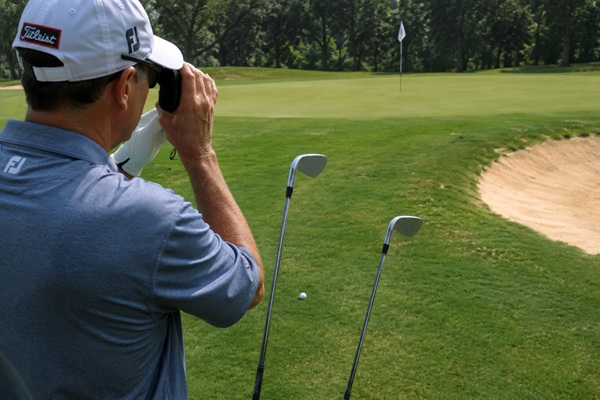
This is the part I didn’t notice at first, but it showed up fast once I paid attention.
It looked like this:
- Laser the flag
- Laser a bunker short right
- Re-check the flag
- Laser again because the first number “felt off.”
- Pull a club
- Put it back
- Laser one more time
It sounds obsessive written out like that, but on the course it feels normal. It feels like “being precise.”
What’s actually happening is simpler:
- You stop trusting the first reading
- You assume more checking equals better certainty
- You delay commitment until you feel fully “safe.”
- When the device vibrates to confirm it locked onto the pin, it triggers a hit of dopamine. Your brain completely shuts off its evaluation of the 20-yard drop-off to the left of that pin because the technology gave you a sense of completion.
That’s where the shift starts. Not in the device itself, but in how quickly you start doubting your own first decision.

The real issue: outsourcing confidence to a number
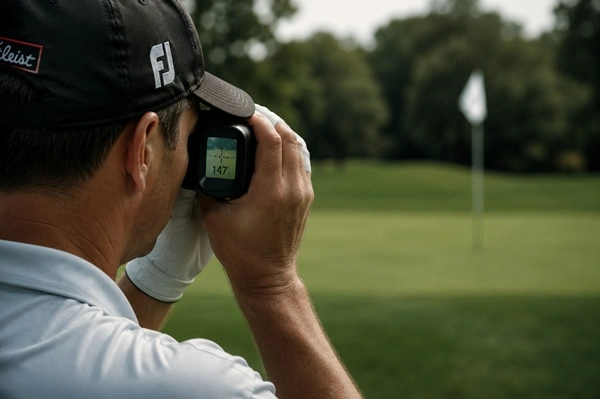
Before I used a rangefinder, my process was straightforward:
“This is about a 7-iron. Commit and hit.”
After a few weeks with one, it turned into:
“Let me check the number first.”
That change sounds small, but it isn’t.
What I noticed happening:
- My internal yardage memory got weaker
- I started treating feel as “rough estimation” instead of usable data
- I delayed commitment until I got external confirmation
Even worse, I started checking yardages I already knew. Not for information. For reassurance.
That’s the real dependency loop. The number stops being useful data and becomes permission to commit.
How exact yardages distort shot selection
A precise number like 147 or 163 doesn’t just tell you distance. It compresses how you see the entire shot.
It becomes:
- 147 = 7-iron
- 163 = firm 6-iron
- 128 = smooth wedge
Clean. Simple. Almost too clean.
The problem is what gets pushed out of the decision.
Not because I forgot these things exist, but because the exact number makes them feel less important in the moment.
The brain starts doing something subtle here:
- It locks onto the yardage as the main problem to solve
- It treats everything else as secondary adjustments
- It delays miss strategy until after club selection
So instead of building the shot around safety, I started building it around matching the number.
Features like Slope Compensation make this trap even worse. When the Bushnell calculates the adjusted slope distance for you, it removes the last bit of active critical thinking required. You stop looking at the actual severe uphill gradient of the green because the screen did the math for you, leaving you entirely unprepared for how the ball will react when it lands.
That’s where shot selection quietly shifts in the wrong direction.
The real problem isn’t accuracy — it’s how certainty takes over
This is the part that actually changed how I play.
The rangefinder doesn’t erase variables like wind, lie, or firmness. It just changes how your brain prioritizes them.
Once I see a number like 147, my thinking starts to narrow:
- I pick a club faster than I should
- I commit earlier than I should
- I stop fully processing where I can afford to miss
Not because I’m ignoring the course. But because the precision makes everything feel already “solved.”
And that’s the shift:
Before:
- Read the situation
- Decide miss strategy
- Then pick a club
After:
- Get number
- Pick club
- Adjust everything else afterward
The order flips. And once it flips, you start playing the number instead of playing the hole.
Pin-hunting bias (the quiet side effect)
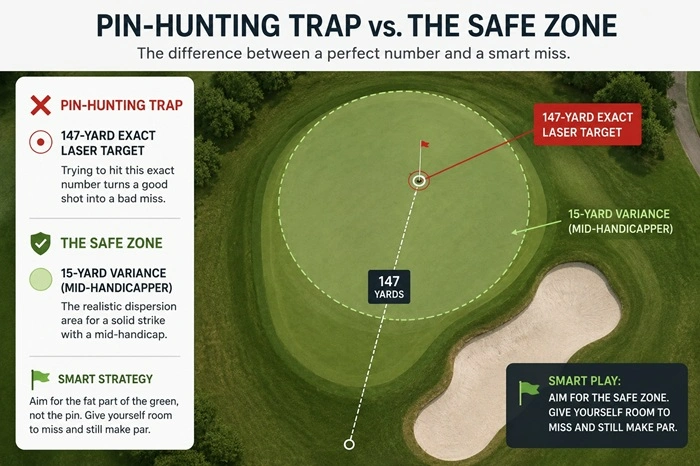
This was one of the first real performance changes I noticed.
Exact yardages make targets feel smaller than they are.
So instead of thinking:
- “Where’s the safe landing area?”
I started thinking:
- “I can hit 147. I’ll go at the flag.”
Not because I suddenly became aggressive, but because precision made the target feel more controlled.
That’s pin-hunting bias.
And it’s dangerous because golf doesn’t reward control over numbers. It rewards control over misses.
The 3-Step “Anti-Overthinking” Pre-Shot Checklist
To stop yourself from outsourcing your confidence to the screen, you have to break the data loop before you take your practice swing. Next time you pull out your rangefinder, run through this 3-point mental checklist to keep your focus on execution rather than perfection:
-
1. Laser the back edge or the hazard, not just the pin: Finding the exact yardage to the flag triggers a subconscious urge to hunt it. Laser the danger zones first so your brain calculates a safe landing zone before it ever looks at the flag.
-
2. Check the wind at the treetops, not just the ball: A rangefinder gives you a sterile, static number. Forcing yourself to look up at the trees breaks the screen’s spell and reminds your brain that live, environmental elements are still in play.
-
3. Pick the club for your mis-hit, not your perfect strike: If the device tells you it’s 147 yards, don’t grab the club that only goes 147 when you catch it absolutely pure. Choose the club that still leaves you safely on the surface if you strike it slightly thin or heavy.
The learning curve nobody explains properly
Using a rangefinder isn’t linear improvement. It moves in phases.
Phase 1: Overuse (everything gets measured)
- Every shot gets lasered
- Even obvious distances are checked
- Confidence shifts from memory → device
At this stage, it feels like you’re leveling up. You’re not. You’re outsourcing judgment.
Phase 2: Confusion (decision friction)
- Multiple checks per shot
- Slower pre-shot routine
- Second-guessing known yardages
This is where I actually played worse. Not because I lost skill, but because I lost rhythm.
Phase 3: Adaptation (selective trust)
- Only uncertain shots get measured
- Stock distances come back naturally
- Rangefinder becomes confirmation, not authority
This is the only stage where performance stabilizes.
When it started helping instead of hurting
The shift wasn’t technical. It was behavioral.
I stopped asking the rangefinder to decide things for me.
Now I use it for:
- Confirming carries over hazards
- Verifying distances on unfamiliar courses
- Double-checking only when uncertainty is real
Everything else goes back to instinct and repetition.
What changed:
- Faster decisions
- Less hesitation over routine shots
- More consistent shot selection under pressure
The device didn’t make me better. It just stopped getting in the way once I used it less.
When I don’t use it at all
There are situations where I just leave it alone:
- Comfortable wedge distances I already know
- Familiar courses where yardages are internalized
- Shots where rhythm matters more than precision
- Simple approaches where checking adds hesitation
On those shots, the rangefinder doesn’t add value. It interrupts flow.
Before vs after rangefinder use
| Situation | Before Rangefinder | After Rangefinder (Early Use) |
|---|---|---|
| 150-Yard Approach | Instinct + quick club choice | Multiple checks + hesitation |
| Hazard Decision | Conservative play | Aggressive carry calculation |
| Pre-Shot Routine | 10–15 seconds | 30–60 seconds |
| Confidence Source | Feel + repetition | Number validation |
Conclusion
A golf rangefinder doesn’t automatically improve decision-making. In my experience as a 14-handicap golfer using a Bushnell Tour V5, it actually made things worse before it made them better.
Not because the device is flawed, but because it introduces precision faster than judgment can adapt to it.
That gap changes behavior. You start outsourcing confidence, over-checking simple shots, and prioritizing numbers over situation awareness.
The improvement only comes later, when the rangefinder stops being the decision-maker and becomes a simple reference point again. That’s when it actually starts helping your game instead of shaping it.